
Comparison · 6 min read · 2026-09-02
Touch Lamp vs Smart Lamp: Which Belongs on Your Nightstand?
Both promise easier bedside lighting, but they solve different problems. A touch lamp is a physical object you tap; a smart lamp is a small computer you talk to. Here is how they compare where it actually matters — in the dark, half-asleep, at the end of a long day.
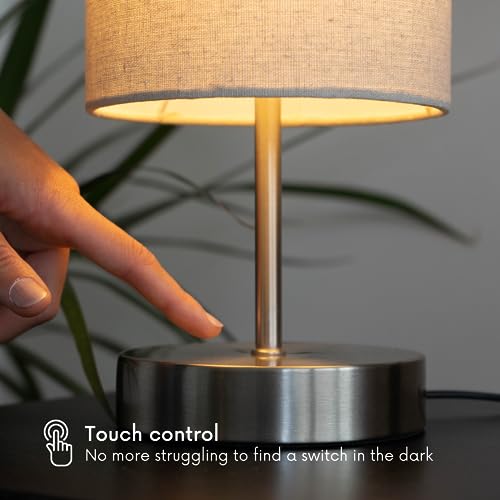
Setup: minutes versus none
A touch lamp works the moment it is plugged in. There is no account, no app, no 2.4GHz-only Wi-Fi quirk to work around, and nothing to re-pair when your router is replaced.
Smart lamps need a phone, a network and usually a hub or ecosystem choice. That is fine for a living room scene you set once, but it is a lot of dependency for a light you use for ninety seconds before sleep.
Night-time use: the two-second test
The honest test for any bedside light is how it behaves at 3am. Tapping a metal base takes under a second and needs no eyes. Unlocking a phone, opening an app and waiting for it to connect wakes you up properly — which is the opposite of what you want.
Voice control avoids the phone, but speaking out loud is not neutral in a shared bedroom, and a mis-heard command that floods the room with cool white light is a genuinely bad way to end the night.
Dimming quality
Smart lamps win on paper: any brightness, any colour temperature, schedules and sunrise fades. In practice most people settle on two or three levels and never change them again.
That is exactly what three-step touch dimming gives you — a reading level, a winding-down level and a low glow — with the important detail that the steps are chosen to suit a bedroom rather than left to a slider.
Charging and cable clutter
This is where the comparison usually ends. A touch lamp with USB-A and USB-C ports in the base replaces the plug adapter, and lets a phone and a watch charge from the lamp itself.
Very few smart lamps include charging ports, so you keep the adapter, the extension lead and the tangle. In a small Hong Kong bedroom with one socket behind the bed, that difference is the whole decision.
Cost and lifespan
A good touch lamp sits under £30 and takes a standard E27 bulb, so replacements cost a couple of pounds and are sold everywhere. Nothing in it can stop being supported.
Smart lighting starts higher, and its usefulness depends on an app and a cloud service that may be deprecated long before the bulb fails. Buy smart for colour and automation; buy touch for a light you will still use in ten years.
Frequently asked questions
- Can I use a smart bulb in a touch lamp?
- You can, but you should not control both at once — the touch circuit and the bulb's own dimming will fight each other and may flicker. Pick one dimming method.
- Do touch lamps use standby power?
- A tiny amount, to keep the capacitive sensor listening. It is comparable to any smart plug and far less than a lamp left on a low setting overnight.
- Which is better for a rented flat?
- A touch lamp. Nothing is tied to a network, a hub or a fixed installation, so it moves with you and works on day one.
The Caza Touch Lamp gives you three-step touch dimming, a warm linen shade and USB-A + USB-C charging in the base.
Shop the Caza Touch Lamp